

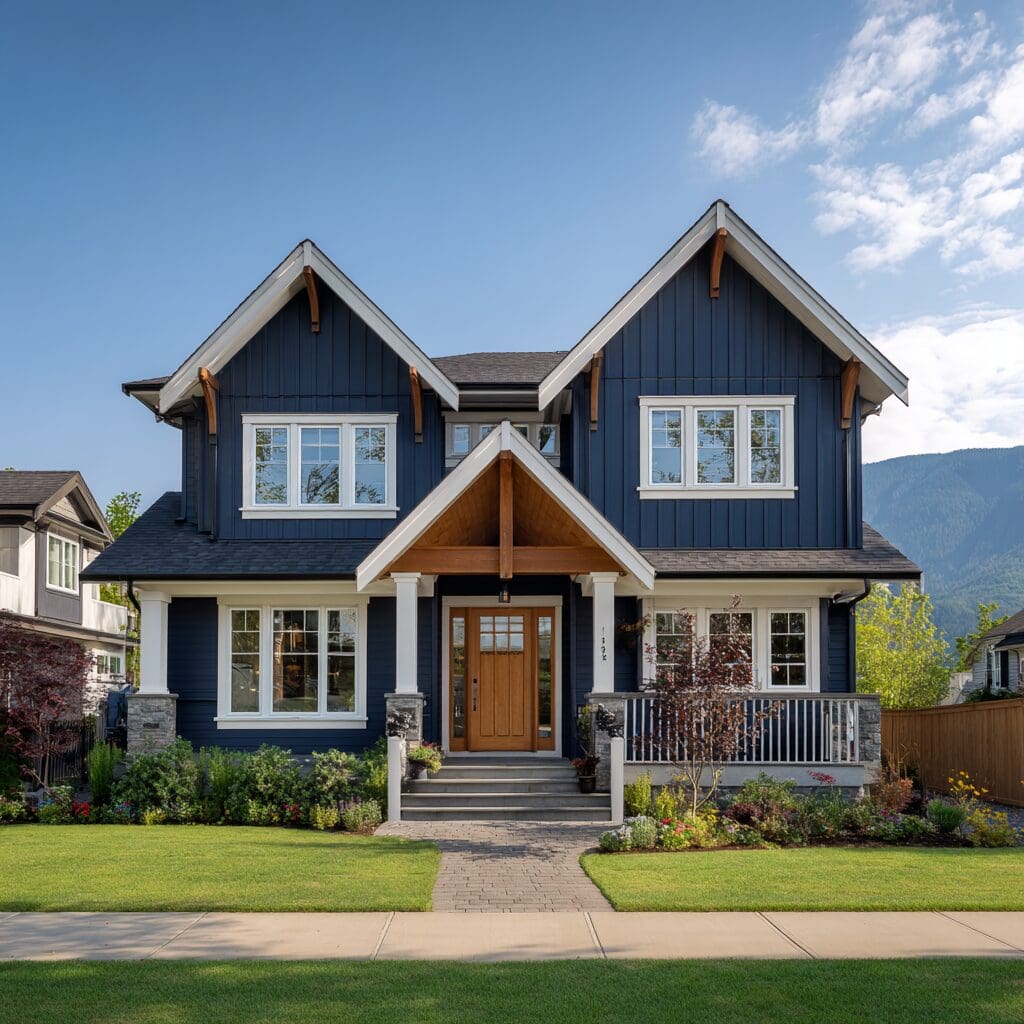
A project management guide for homeowners in Chilliwack, Sardis, and the Eastern Fraser Valley.
The difference between a paint job that lasts three years and one that lasts fifteen comes down to surface preparation, product selection, and the crew executing the work. In Chilliwack, that gap is wider than most of BC — because our climate punishes shortcuts faster than almost anywhere else in the province.
Chilliwack receives approximately 1,500 millimetres of rain annually. Homes in Sardis, Promontory, and the Vedder area face prolonged moisture exposure from fall through spring, followed by summer heat that drives rapid expansion and contraction of exterior surfaces. This cycle is the primary factor in paint failure — and most painting companies in the Fraser Valley never discuss it with homeowners.
What to Evaluate Before Hiring a Painter
Before you get to discussing colours, you need to ensure the business you are hiring is legitimate and structured to protect you as the homeowner.
WCB Coverage and Liability Insurance
This is non-negotiable. A painting contractor working on your property without WorkSafeBC (WCB) coverage exposes you to personal liability if a worker is injured on your site. In British Columbia, homeowners can be held responsible for workplace injuries when they hire uninsured contractors.
Before signing any agreement, ask for:
- A current WCB clearance letter (not just a registration number — a clearance letter confirms the account is in good standing with no outstanding assessments)
- Proof of commercial general liability insurance (minimum $2 million is standard for residential work in BC)
Legitimate contractors provide these without hesitation. If a painter cannot produce both documents, that tells you everything you need to know about how the rest of the project will be managed.
Guaranteed Quoting vs. Estimates
There is a meaningful difference between an estimate and a guaranteed quote. An estimate is a rough projection that can change once work begins. A guaranteed quote is a fixed price for a defined scope of work — materials, labour, prep, and cleanup included.
For Chilliwack homeowners, guaranteed quoting matters because exterior projects frequently reveal hidden issues once prep work begins: rotting trim, moisture damage behind siding, failed caulking around windows. A professional contractor identifies these conditions during the quoting walkthrough, not after the scaffolding is up. The quote should account for anticipated repairs or clearly define what falls outside scope.
Key Question
Ask specifically: Is this a guaranteed quote or an estimate? What happens if you discover damage during prep?
Crew Qualifications and Project Management
What matters is who is managing your project and whether the person quoting the job stays involved in quality control throughout.
Key questions:
- Who will be on site daily? Is there a lead painter accountable for the finished result?
- How do you handle scheduling around weather? (This is critical in the Fraser Valley — exterior work requires dry windows that are unreliable from October through April.)
- Do you have in-house design consultation, or is colour selection left entirely to the homeowner?
Having access to a trained interior designer during the planning phase is a significant advantage for renovation projects. Colour choices affect perceived room size, lighting quality, and the cohesion of finishes across connected spaces. This is not a luxury — it is a practical step that prevents costly repaints when a homeowner realizes the colour they chose online looks entirely different on a south-facing wall at 3 PM.
Why Prep Work Determines Whether Your Paint Job Lasts
Every painting company in Chilliwack will tell you they do thorough prep work. The question is what that actually means in practice.
Exterior Prep in the Fraser Valley
Exterior surfaces in Chilliwack face a specific set of challenges that differ from drier climates. Moisture is the primary enemy — not sunlight, not temperature alone, but water entering substrate through failed coatings, open joints, and compromised caulking.
Professional exterior prep includes:
- Pressure washing at appropriate PSI for the substrate (too high damages wood fibre; too low fails to remove contaminants)
- Moisture testing of wood surfaces before priming — painting over damp wood is the most common cause of premature paint failure in the Fraser Valley
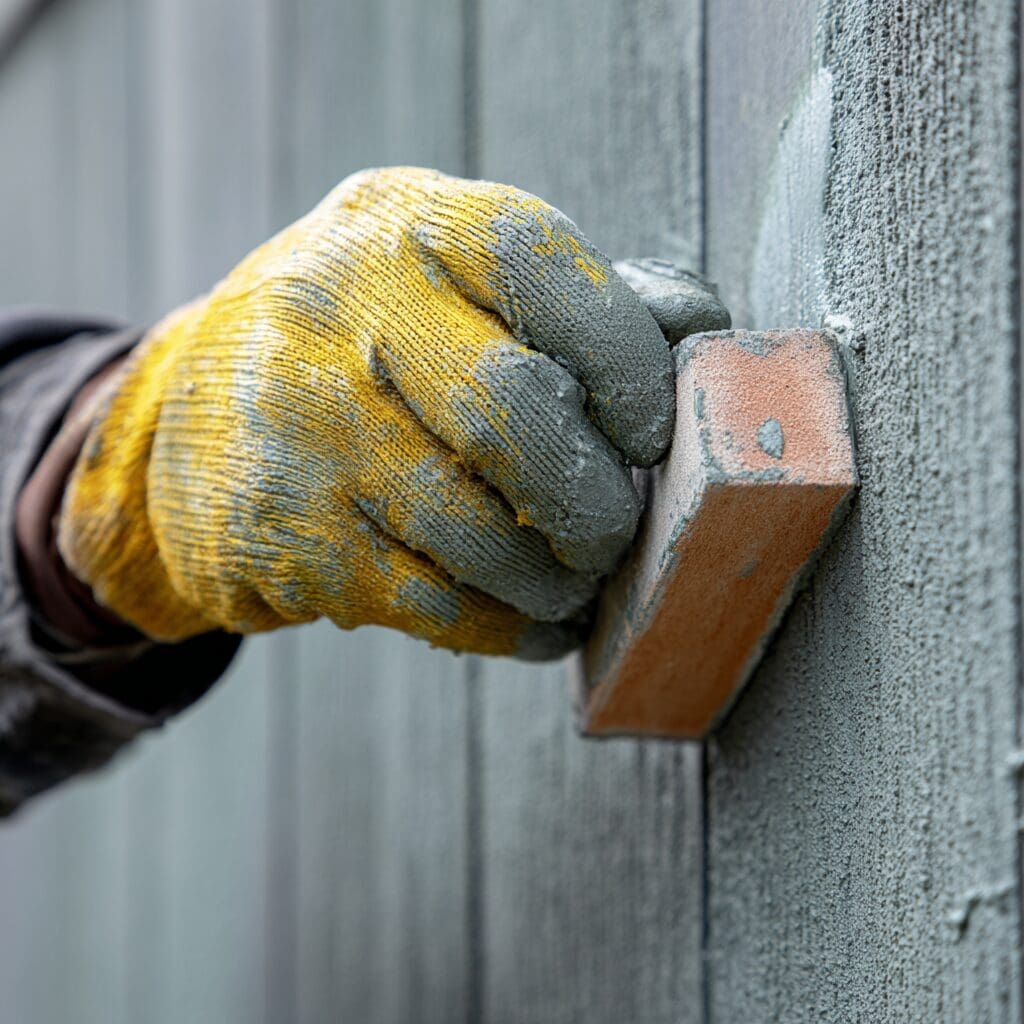
- Scraping and sanding all loose, peeling, or chalking paint down to a sound surface
- Caulking replacement around all window and door frames, trim joints, and penetrations — old caulk that has hardened or separated is a direct moisture entry point
- Rot assessment and repair — trim boards, fascia, and soffits in Chilliwack homes frequently show moisture damage that is invisible under existing paint. This must be repaired before new paint is applied, not painted over.
- Priming all bare wood and repaired areas with a moisture-blocking primer rated for Pacific Northwest conditions
Skipping any of these steps produces a paint job that looks acceptable on day one and fails within two to four years. In Chilliwack’s climate, every shortcut shows up as peeling, bubbling, or mould growth within 24 months.
Interior Prep Standards
Interior prep follows the same principle — the finish is only as good as the surface beneath it:
- Wall repair: filling holes, seams, and cracks with appropriate compound, sanding smooth
- Surface cleaning: removing dust, grease, and nicotine residue that prevents adhesion
- Priming: stain-blocking primer on water stains, smoke damage, and oil-to-latex transitions
- Masking and protection: professional-grade tape, drop cloths on all flooring, removal of fixtures and hardware
Product Selection for the Fraser Valley Climate
The climate demands specific formulations to ensure longevity.
Exterior Paints
Not all exterior paints perform equally in high-moisture environments. For Chilliwack homes, the critical performance characteristics are:
- Moisture resistance: acrylic latex formulations outperform oil-based paints in damp climates because they allow moisture vapour to pass through the film rather than trapping it beneath the surface
- Flexibility: paint films must expand and contract with temperature swings without cracking — elastomeric coatings are appropriate for stucco and masonry, while premium acrylic latex handles wood siding
- Mould and mildew resistance: factory-added mildewcides are essential for north-facing walls, soffits, and any surface with limited sun exposure — common conditions in Sardis and Vedder-area properties surrounded by mature tree canopy
- UV resistance: while moisture is the primary concern, south and west-facing surfaces still require UV-stable pigments to prevent premature fading
Professional painters select products based on the specific substrate and exposure conditions of your home — not a single product for every surface.
Interior Paints
Interior product selection is driven by room function: semi-gloss or satin for kitchens and bathrooms (moisture and scrub resistance), eggshell for living areas (softer aesthetic with washability), semi-gloss enamel for trim and cabinets (durability), and flat for ceilings (hides imperfections). Low-VOC and zero-VOC formulations are standard in quality interior products and should be expected — particularly in homes with children or occupants with respiratory sensitivities.
The Renovation Advantage: When Painting Is Part of a Larger Project
Many Chilliwack homeowners hire a painter as part of a broader renovation — a kitchen update, a bathroom refresh, or a full interior modernization. When painting is coordinated with renovation work, sequencing matters.
Paint should be applied after drywall, mudding, and sanding are complete; after trim is installed but before final hardware; and after plumbing and electrical rough-ins are closed. Getting this sequence wrong creates rework.
A company that handles both renovations and painting in-house eliminates the coordination gaps between separate trades. One project manager controls sequencing, quality checkpoints happen at each phase, and the homeowner deals with a single point of contact.
For cabinet refinishing as part of a kitchen renovation, in-house design consultation ensures cabinet colour, wall colour, countertop, and hardware work as a cohesive system — not a collection of individually selected finishes that clash under the kitchen’s actual lighting.
Master Painting & Renovations
Serves Chilliwack, Sardis, Promontory, Vedder, and the eastern Fraser Valley. WCB insured, guaranteed quoting, and in-house design consultation on every project. Request a quote or call to schedule a walkthrough.
Frequently Asked Questions
How long does an exterior paint job last in Chilliwack?
With proper prep, quality product, and professional application: 10 to 15 years on wood siding, 15 to 20 years on fibre cement, and 8 to 12 years on stucco. Without proper prep, expect visible failure in 2 to 4 years — regardless of the paint brand used.
When is the best time to paint exteriors in the Fraser Valley?
May through September offers the most reliable dry conditions. Exterior paint requires a minimum of 10°C surface temperature and at least 24 hours without rain after application. Professional contractors monitor Environment Canada forecasts and schedule exterior work around confirmed dry windows.
Do I need to be home during a painting project?
Not necessarily. Most professional painters can work independently once the scope is confirmed. However, being available for the initial walkthrough and final inspection ensures expectations are aligned.
How do I know if my home needs repainting or just touch-ups?
Run your hand across the exterior surface. If paint chalks off on your fingers, the coating is degrading. If you see bubbling, peeling, or exposed wood anywhere, full prep and repaint of affected areas is required. Spot touch-ups on degraded coatings will not adhere properly and will fail quickly.
What should a painting quote include?
A complete quote specifies: number of coats, product brand and line, prep work scope (washing, scraping, priming, caulking, repairs), surfaces included and excluded, timeline, payment terms, WCB and insurance confirmation, and warranty terms. If any of these are missing, ask for clarification before signing.
Is cabinet painting worth it compared to replacement?
Professional cabinet refinishing typically costs 40 to 60 percent less than full replacement. When combined with new hardware and updated colour, refinished cabinets are visually indistinguishable from new — and original cabinet boxes, if structurally sound, often outperform budget replacements in material quality.