

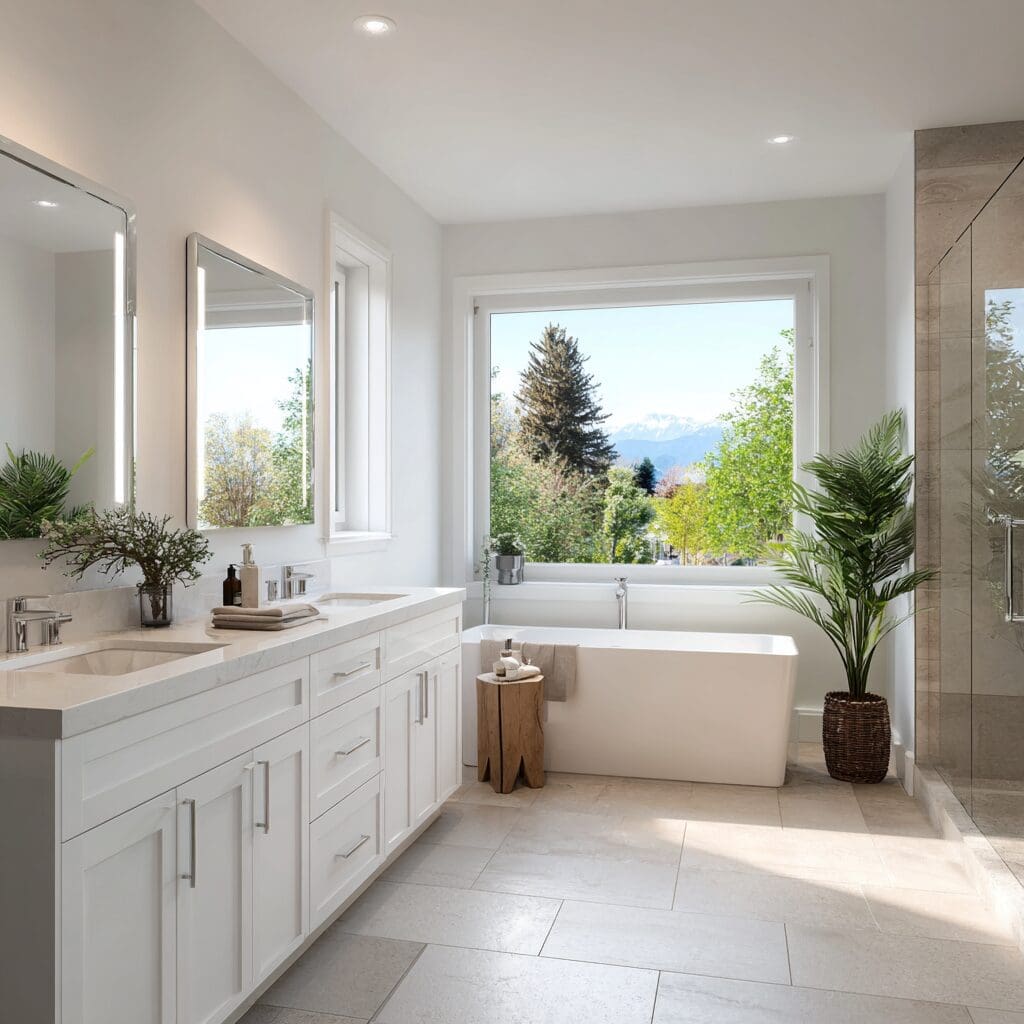
A project management guide for homeowners in Chilliwack, Sardis, Promontory, and the Eastern Fraser Valley.
Most bathroom renovations in Chilliwack look great on completion day. The ones that hold up ten years later are the ones where the invisible work — waterproofing, ventilation, substrate preparation — was done correctly before a single tile was set.
The Fraser Valley’s humidity and prolonged wet seasons expose substandard bathroom construction faster than drier climates. Insufficient waterproofing leads to mould in wall cavities. Inadequate ventilation lets moisture accumulate in structural assemblies. Improper substrate selection leads to swelling and grout failure within 3 to 5 years.
Defining Your Renovation Scope
Bathroom renovations range from cosmetic refreshes to full structural rebuilds. Defining your scope before contacting contractors prevents misaligned expectations and budget overruns.
Cosmetic Refresh ($5,000–$12,000)
A cosmetic refresh updates the visible surfaces without altering layout, plumbing, or electrical:
- New paint (walls, ceiling, trim)
- Updated vanity, mirror, and lighting fixtures
- New faucets and hardware
- Re-caulking around tub, shower, and floor transitions
- Updated accessories (towel bars, toilet paper holder, shower rod)
This scope does not typically require a building permit and can be completed in one to two weeks. It is appropriate when the existing plumbing, waterproofing, and substrate are in sound condition.
Mid-Range Renovation ($15,000–$30,000)
A mid-range renovation involves replacing fixtures, tile, and potentially reconfiguring the vanity or shower area:
- Full tile replacement (floor and walls)
- New shower enclosure or tub-to-shower conversion
- Vanity replacement with new countertop and sink
- Toilet replacement
- Updated lighting and exhaust fan
- Waterproofing membrane installation behind all tiled wet areas
- Potential plumbing relocation for fixture repositioning
This scope typically requires a building permit if plumbing or electrical is being moved or added.
Full Renovation ($30,000–$55,000+)
A full renovation involves demolition to studs and complete rebuild:
- Gut demolition of all existing finishes, fixtures, and potentially framing
- Plumbing rough-in reconfiguration
- Electrical upgrade (dedicated circuits, GFCI outlets, heated floor wiring)
- New waterproofing system throughout
- Custom tile work (floor, walls, shower niche, bench)
- Custom or semi-custom cabinetry
- Stone or engineered countertops
- Glass shower enclosure
- In-floor heating
- Upgraded ventilation system
Full renovations require a building permit from the City of Chilliwack and involve plumbing, electrical, and potentially structural inspections.
Waterproofing: The Most Critical Step Nobody Discusses
This is where bathroom renovations succeed or fail in the Fraser Valley — and it is the step most commonly rushed or skipped by contractors who prioritize visual finish over structural integrity.
What Proper Waterproofing Involves
Every tiled wet area in a bathroom requires a continuous waterproofing membrane between the substrate and the tile. This is not optional. It is required by good building practice and is the single most effective defence against mould growth, substrate deterioration, and structural damage.
Professional waterproofing systems include:
- Sheet membrane systems (Schluter KERDI, Laticrete Hydro Ban Sheet): pre-formed waterproof sheets applied over substrate before tile installation. These provide the most reliable, testable waterproof barrier.
- Liquid-applied membranes (RedGard, Mapei AquaDefense, Laticrete Hydro Ban): rolled or brushed onto substrate in multiple coats. Effective when applied at the correct mil thickness — too thin and the membrane fails.
- Shower pan systems: pre-formed or site-built waterproof bases for shower floors that direct water to the drain. Failure at the shower pan is the most common source of water damage in bathroom renovations.
What to Ask Your Contractor
Before signing a bathroom renovation contract, ask specifically:
- What waterproofing system do you use in shower areas?
- Do you waterproof behind tile in all wet areas, including tub surrounds?
- How do you handle transitions between the shower floor and walls?
- Do you flood-test shower pans before tiling?
A contractor who cannot answer these questions in specific, technical terms is not qualified to renovate a bathroom in a high-moisture climate.
Ventilation: BC Building Code Requirements
The BC Building Code strictly requires mechanical ventilation in all bathrooms. The absolute minimum requirement is an exhaust fan rated to move sufficient air volume for the room size, typically 50 CFM for a standard bathroom and 1 CFM per square foot for larger spaces.
However, in the Fraser Valley, simply meeting minimum code requirements is often insufficient for long-term durability. To properly protect your property, the best practice is to install a timer or humidity-sensing switch that keeps the fan running for 20–30 minutes after shower use to remove all residual moisture from the room.
Furthermore, all exhaust must be properly ducted and vented directly to the building exterior—never into the attic or soffit, which is a common but damaging shortcut that leads to condensation and mould. In unheated spaces, it is also crucial that this ductwork be insulated to prevent condensation from forming within the duct. Inadequate ventilation in a Chilliwack bathroom is a significant structural concern, not just a matter of comfort, as unexhausted moisture will inevitably accumulate in wall and ceiling assemblies, creating conditions for mould and material degradation that often remains invisible until significant damage has occurred.
Material Selection for Fraser Valley Bathrooms
Choosing the right materials for a wet environment is critical.
Tile and Flooring
Porcelain tile is the most durable flooring option for Fraser Valley bathrooms — it is non-porous, resistant to moisture absorption, and dimensionally stable. Natural stone (marble, travertine) requires sealing and ongoing maintenance to prevent staining and moisture penetration. Luxury vinyl plank is an appropriate alternative for powder rooms and low-moisture bathrooms but is not recommended for shower surrounds or high-splash zones.
Substrate
Cement board (Durock, HardieBacker) or foam board systems (Schluter KERDI-BOARD) are the only appropriate substrates behind tile in wet areas. Standard drywall — even moisture-resistant “green board” — is not adequate for direct tile application in shower or tub surrounds. It will absorb moisture through grout lines and degrade.
For walls and ceilings not in direct wet areas, mold-resistant drywall (commonly called “purple board”) provides additional protection against ambient humidity.
Countertops
Quartz is the most practical bathroom vanity countertop: non-porous, no sealing required, and resistant to moisture and staining. Granite performs well but needs periodic sealing. Laminate works for powder rooms on a budget.
The Chilliwack Building Permit Process
The City of Chilliwack requires a building permit for bathroom renovations that involve:
- Any plumbing relocation or addition (moving a toilet, adding a drain, repositioning supply lines)
- Electrical work beyond fixture replacement (new circuits, GFCI installation, heated floor wiring)
- Structural modifications (removing or altering walls, headers, or load paths)
- Changes to ventilation ducting
Cosmetic updates — paint, vanity replacement, fixture swaps where plumbing connections remain unchanged — do not require a permit.
The process involves submitting plans to the City’s building department, paying applicable fees, and scheduling inspections at defined stages (rough-in plumbing, rough-in electrical, insulation/vapour barrier, and final). A qualified contractor manages this on your behalf and schedules inspections to avoid project delays.
Liability Warning
Unpermitted work creates real liability. It can affect home insurance coverage, complicate resale, and result in orders to open completed work for inspection — demolishing finished surfaces to expose what is behind them.
How to Evaluate a Bathroom Renovation Contractor
Before signing a contract, it is essential to verify that your contractor meets specific local qualifications. Ensure they have WCB (WorkSafeBC) coverage by requesting a current clearance letter confirming their account is in good standing. They should also carry commercial general liability insurance with a minimum of $2 million for residential work in BC, along with a valid City of Chilliwack business licence for the specific type of work being performed. Finally, always ask for references from completed bathroom renovation projects in the Chilliwack area that you can personally verify or visit.
A professional bathroom renovation contractor should also adhere to high project management standards. This begins with providing a guaranteed quote—not just a rough estimate—that clearly defines the scope, materials, timeline, and payment schedule. This should be accompanied by a written contract specifying warranty terms, the change order process, and completion criteria.
The process should follow a clear project timeline with milestones for demolition, rough-in, inspections, waterproofing, tile, fixtures, and the final punch list. Additionally, look for in-house design support to assist with fixture selection, layout optimization, and material coordination. This ensures that every element, from the paint and tile to the vanity and hardware, works together as a cohesive design rather than a collection of mismatched finishes.
Master Painting & Renovations
Delivers full-scope bathroom renovations in Chilliwack, Sardis, Promontory, and the Eastern Fraser Valley — from demolition through final paint. WCB insured, guaranteed quoting, and in-house design consultation. Request a quote to start planning your renovation.
Frequently Asked Questions
How long does a bathroom renovation take in Chilliwack?
A cosmetic refresh: 1–2 weeks. A mid-range renovation: 3–5 weeks. A full gut renovation: 6–10 weeks, depending on permit processing, inspection scheduling, and material lead times. Custom tile work and stone countertops may extend timelines due to fabrication schedules.
Do I need a permit to renovate my bathroom in Chilliwack?
If you are moving plumbing, adding electrical circuits, or modifying structure — yes. Cosmetic updates (paint, vanity swap, fixture replacement without moving connections) do not require a permit. When in doubt, call the City of Chilliwack building department. The penalty for unpermitted work is significantly more expensive than the permit itself.
Can I live in my home during a bathroom renovation?
Yes, if you have a second bathroom available. Your contractor should establish clear working hours, dust containment, and daily cleanup. Full gut renovations may require temporary water shutoffs.
What is the biggest mistake homeowners make?
Choosing finishes before confirming infrastructure. Waterproofing, ventilation, and substrate preparation determine whether those finishes last five years or twenty. The invisible decisions matter most.
Should I choose a general contractor or a specialist?
A contractor who handles demolition through final paint in-house provides tighter project management than assembling separate trades. One point of contact, one timeline, one quality standard.