Blog Professional Painter
What Credentials Should a BC Painting Contractor Have?
Accredited & Certified




- WorkSafeBC (WCB) coverage is mandatory for any BC contractor with employees and protects you from liability if someone is injured on your property.
- A business licence, GST registration, and liability insurance are the three pillars of a legitimate painting operation.
- You can verify WorkSafeBC status directly on the WorkSafeBC website at no cost, in about two minutes.
- Asking for certificates of insurance upfront is standard practice, not an unusual request.
- In BC, painting is not a regulated trade requiring provincial certification, but the quality of a contractor's business practices tells you far more than a certificate ever could.
- A written contract, a structured payment schedule, and a clear project timeline are themselves credentials. They reflect how a contractor actually operates.
If you have spent any time looking for a painting or renovation contractor in the Fraser Valley, you have probably found yourself in a familiar position: a handful of quotes in front of you, each from someone who seems reasonable on the phone, and no clear way to tell them apart. The prices differ. The personalities differ. But which one is actually legitimate?
This is the question most homeowners are really asking when they search for contractor credentials. It is not a question about certificates on a wall. It is about wanting some way to know, before you hand over a deposit, that the person coming into your home is running a real business with real accountability. That is a fair thing to want, and the answer is clearer than most people expect.
Here is what professional credentials actually look like for a painting contractor operating in British Columbia, what each one means, and how you can confirm them yourself.
WorkSafeBC Coverage: The Most Important Credential to Check First
WorkSafeBC, formerly known as WCB (Workers' Compensation Board), provides wage replacement and medical coverage for workers who are injured on the job in BC. For you as a homeowner, this matters for a specific reason: if a worker is injured on your property and the contractor does not have WorkSafeBC coverage, you can be held liable for the costs. That is not a hypothetical risk. It is a scenario that plays out for homeowners in BC every year.
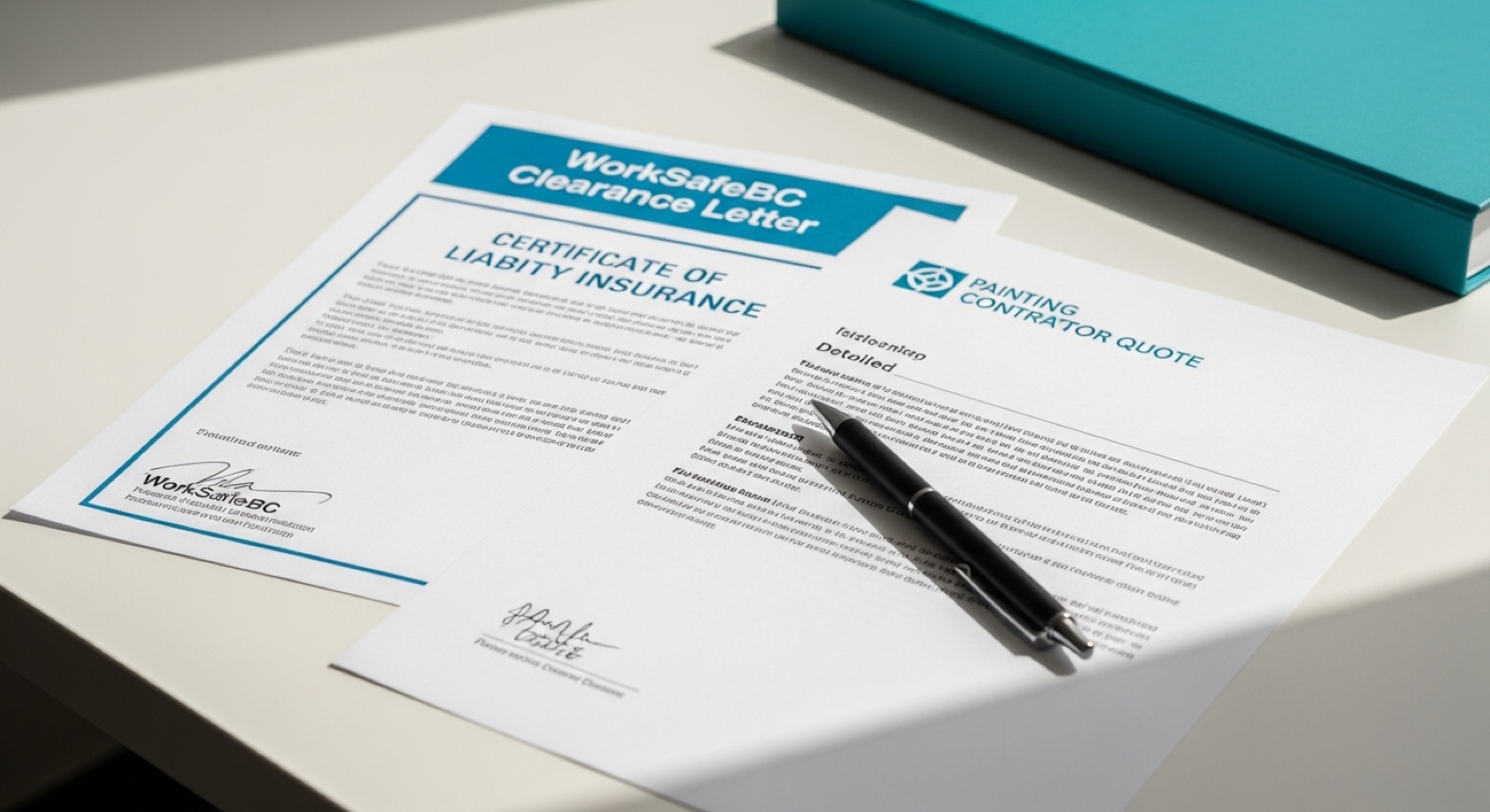
Any painting or renovation company that employs workers is required by BC law to register with WorkSafeBC and maintain active coverage. A sole operator working entirely alone may be exempt, but any company with a crew is not. Before work begins, ask your contractor for their WorkSafeBC account number and verify it yourself at worksafebc.com. The clearance letter search takes about two minutes and costs nothing. If the account is in good standing, the website tells you immediately. If the contractor resists providing this, take it seriously.
When we work on a project in Chilliwack, Sardis, or anywhere else in the Fraser Valley, we provide this information at the quoting stage without being asked. It is part of a standard professional introduction, the same way a doctor's office posts its credentials on the wall. The information should be easy to access and easy to verify.
Liability Insurance: What It Covers and Why You Need to See It
General liability insurance protects your property if a contractor causes damage during the course of the work. A spilled can of paint that ruins a hardwood floor, a ladder that knocks out a window, an accidental water leak from a pipe disturbed during renovation work. These things happen even on well-run jobs. What separates professional contractors from casual operators is whether there is insurance in place when they do.
You should always ask for a certificate of insurance before work begins, specifically for the project period. The certificate should name your property address and show coverage that is currently in force. A policy that expired six months ago does not protect you. A professional contractor carries liability insurance as a basic cost of operating and will not hesitate to provide the certificate.
The coverage amount matters too. For a typical residential painting or renovation project, you want to see general liability coverage of at least two million dollars. Some larger renovation projects require more. Your contractor should be able to tell you the limit on their policy without having to think about it.
A Valid Business Licence
BC municipalities generally require contractors to hold a valid business licence for the city or district where they are based. In Chilliwack, that means a licence issued by the City of Chilliwack. A painting company operating in Abbotsford would hold a business licence there. For regional work across the Fraser Valley, some contractors hold multiple licences, or their base licence covers the primary municipality.
A business licence is not a quality guarantee. It does not tell you how well someone paints. What it does tell you is that the business has registered itself as a legal operating entity, which means there is a paper trail, a business name, and an address attached to the work being done. For a homeowner, this matters if anything goes wrong after the job is complete and you need to reach someone.
Asking to see a business licence is a reasonable request. Most professional contractors keep a copy on file and can produce it alongside their WorkSafeBC certificate and insurance documentation.
GST Registration: What It Signals
In Canada, any business earning more than $30,000 per year in taxable revenue is required to register for GST and collect it from clients. For a painting or renovation company doing any meaningful volume of work, GST registration is not optional; it is a legal requirement.
If a contractor is not charging GST, there are two possible explanations. The first is that they are a sole operator doing occasional small work under the threshold, which is entirely legal. The second is that they are running a business that should be registered and is not, which raises questions about how they are managing other business obligations as well.
For any project of significant scope, a legitimate contractor will charge GST and provide an invoice that includes their GST registration number. You are entitled to ask for that number. You can verify it at canada.ca through the GST/HST registry. This is a step most homeowners do not take, but it takes thirty seconds and confirms a great deal about how seriously the business is run.
Is Painting a Licensed Trade in BC?
This is one of the most common questions homeowners have, and the honest answer may surprise you. In British Columbia, painting is not a regulated trade under the Industry Training Authority (ITA). That means there is no provincial certification a painter is required to hold. Anyone can offer painting services without completing a formal apprenticeship or holding a Red Seal designation.
This is different from electrical work or plumbing, which are regulated trades in BC that require licensure before anyone can legally perform the work. Painting sits in a different category. What this means in practice is that credentials for painters are found not in provincial certifications but in how the business is actually structured and operated.
That said, some professional painters do hold relevant training. The Painting and Decorating Contractors of America (PDCA) offers standards and training programs, and some BC-based painters have completed apprenticeship programs through predecessor industry bodies. A Red Seal designation in painting does exist, though it is not required. A contractor who has pursued formal training has invested in their craft, and that is worth noting.
For renovations that go beyond painting and involve structural, electrical, or plumbing work, the regulated trade requirements apply to those portions of the work. A general contractor managing a full kitchen or bathroom renovation is responsible for ensuring that any licensed trade work (electrical, plumbing) is carried out by the appropriate licensed professionals. Ask specifically who holds the electrical and plumbing licences before signing any renovation contract that touches those systems.
What a Professional Contract Tells You
There is one credential that tells you more about how a contractor operates than any certificate: the quality of the paperwork they put in front of you before the job starts.
A professional painting or renovation contract should include the full scope of work in plain language, the materials to be used by product name and sheen, a start date and projected completion date, a payment schedule tied to project milestones rather than a lump sum at the start, a clear process for any scope changes, and the terms of any warranty being offered on the workmanship.
Over the years working with homeowners across Chilliwack, Sardis, Vedder Mountain, and Promontory, we have seen the same pattern: the projects that go sideways almost always started with vague paperwork. "Interior painting" with no room list, no product spec, no timeline. When the agreed scope becomes a matter of interpretation, disputes follow. The contract is not just a formality. It is the single most important document in the project, and the specificity of what a contractor puts into it tells you exactly how they approach their work.
A homeowner who reads through a detailed contract and finds it clear and complete can feel confident. One who receives a one-paragraph email summary should ask more questions before signing anything. Our post on what to expect at a painting or renovation estimate meeting walks through exactly what that first conversation should look like.
Questions Worth Asking Before You Say Yes
With all of the above in mind, here are the specific questions that give you a clear picture of whether a contractor is operating at a professional standard.
Can you provide your WorkSafeBC clearance letter and your certificate of general liability insurance before we sign? The answer to this should be immediate and affirmative.
Is your business licensed in the municipality where the work is being performed? For most residential projects in Chilliwack or Abbotsford, the answer comes in one conversation.
Will your invoice include a GST number? For any project above a few hundred dollars, this matters.
Who will be on the job site each day, and who is responsible for supervising the work? This is a question about continuity. Professional operations bring the same people back to the same job each day. Crews that change constantly introduce quality control problems regardless of credentials.
What does your payment schedule look like? A deposit to secure the booking is standard. Payments tied to milestones through the project are reasonable. A contractor who asks for full payment upfront, or for a very large percentage before work begins, is departing from standard practice.
What does your workmanship warranty cover, and for how long? A professional contractor stands behind their work. The specific terms of that warranty should be written into the contract, not offered verbally. You can download our Final Quote Guarantee to see exactly how we put that in writing.
At Master Painting & Renovations, we provide full documentation at the quoting stage: WorkSafeBC coverage, certificate of insurance, business licence information, and a detailed written quote with a clear scope and payment schedule. No paperwork surprises, no vague scopes.
If you are planning a painting or renovation project in Chilliwack, Abbotsford, or anywhere in the Fraser Valley, we would be glad to walk you through the process from the first conversation.
Have more questions about the renovation or painting process? Browse our full FAQ page or call us directly at (604) 847-0994.