Blog Renovation
The BC RAHA Rebate: Who Actually Qualifies for Up to $20,000 in Accessibility Renovations
Accredited & Certified



- BC RAHA is a real, currently active rebate program — up to $20,000 toward approved accessibility renovations. You don't repay it.
- It is not available simply for being a senior. Eligibility requires a permanent disability or lasting physical ability loss in the household.
- Household income must be below $146,270 before tax, and household assets (excluding home equity) must be below $100,000.
- You must apply and receive written approval before starting any work.
- Funding renews April 1 each year and runs first-come, first-served until it's gone — earlier in the year is better.
You may have heard something about a provincial program that helps BC homeowners pay for accessibility renovations. Maybe a friend mentioned it at coffee, or you came across it while looking into ways to make your bathroom safer.
If you're a homeowner in Chilliwack or the Fraser Valley wondering whether this applies to you, it's worth understanding clearly what the program covers and who actually qualifies — because there are a few details that tend to get misrepresented online.
The BC Rebate for Accessible Home Adaptations (BC RAHA) is a real, currently active program administered by BC Housing. It provides up to $20,000 in rebates toward approved accessibility work in your home. This guide covers how it works, who is eligible, what it pays for, and what the application process actually looks like.
What BC RAHA Is (And What It Isn't)
BC RAHA is a rebate program, not a loan. You do not repay it. BC Housing provides funding toward eligible home adaptation work, and the goal is straightforward: to help British Columbians with a permanent disability or lasting physical ability loss stay safely and independently in their own homes for longer.
The program currently offers up to $20,000 in rebates toward approved adaptation costs. That figure covers a meaningful range of work — from a single grab bar installation to a complete bathroom conversion with a zero-threshold walk-in shower.
One thing worth stating clearly at the outset: BC RAHA is not a general renovation grant, and it is not available to any homeowner over a certain age simply by virtue of being a senior. Eligibility requires that you or someone in your household has a disability or permanent loss of physical ability, and the adaptations you're requesting must directly relate to that condition.
That's the detail that most online summaries either gloss over or get wrong. We'll get into exactly what it means below.
- Maximum rebate: Up to $20,000 toward approved accessibility work
- Repayment: None — it's a rebate, not a loan
- Administered by: BC Housing (provincial Crown Corporation)
- Funding cycle: Renews April 1 annually, first-come first-served
- Time to complete work after approval: 180 days
- Previously known as: Home Adaptations for Independence (HAFI)
Who Qualifies for BC RAHA
The eligibility criteria are specific. Here is what BC Housing requires as of 2026.
You or someone in your household has a disability or permanent loss of ability. This is the foundational requirement. The program exists to fund adaptations that respond to a real, ongoing physical condition — not preventative improvements in anticipation of future need. If you have arthritis that makes your current bathroom hazardous, limited mobility following a surgery, or a household member with a disability that affects how they move through the home, you are in the right territory. If you simply want to future-proof your home as a precautionary measure, BC RAHA likely isn't the right fit, though other programs may be.
The adaptations must relate directly to that disability or ability loss. You can't apply for a general kitchen refresh and include a grab bar on the list. Every item funded under BC RAHA needs to be clearly connected to the disability or condition you've documented. An occupational therapist or physiotherapist assessment is required for many adaptation types and helps establish this connection formally.
Household income must be below $146,270 before tax. This is the current income threshold published by BC Housing. It's higher than many people expect, which means a significant number of Chilliwack and Fraser Valley homeowners living on pension income, CPP, OAS, and modest investment income will qualify.
Household assets must be below $100,000, not counting the equity in the home being adapted. Bank accounts, investments, and other assets are assessed, but your home equity is excluded from this calculation.
The home must be your primary residence. Rental properties, investment properties, and vacation properties are not eligible.
The BC Assessment value of your home must fall below BC RAHA's Home Value Limits for your area. BC Housing publishes these limits and updates them periodically. Most single-family homes in Chilliwack and the Fraser Valley fall well within these thresholds, though it's worth confirming before you apply.
One of the most common questions we hear from homeowners in Sardis, Vedder, and Promontory is whether their specific situation rises to the level of a "permanent disability." The program's language includes "lasting ability loss," which is broader than a formal disability diagnosis. If a condition is ongoing and affects your ability to safely perform daily activities in your home, it's worth contacting BC Housing directly to ask whether your circumstances are within scope before you rule yourself out.
What Kinds of Work Does BC RAHA Cover?
The adaptations covered by BC RAHA are the ones that make the most practical difference for homeowners dealing with mobility limitations, balance concerns, or reduced strength. Based on our work with homeowners across the Fraser Valley, the most common projects funded through the program fall into a few categories.
Bathroom modifications
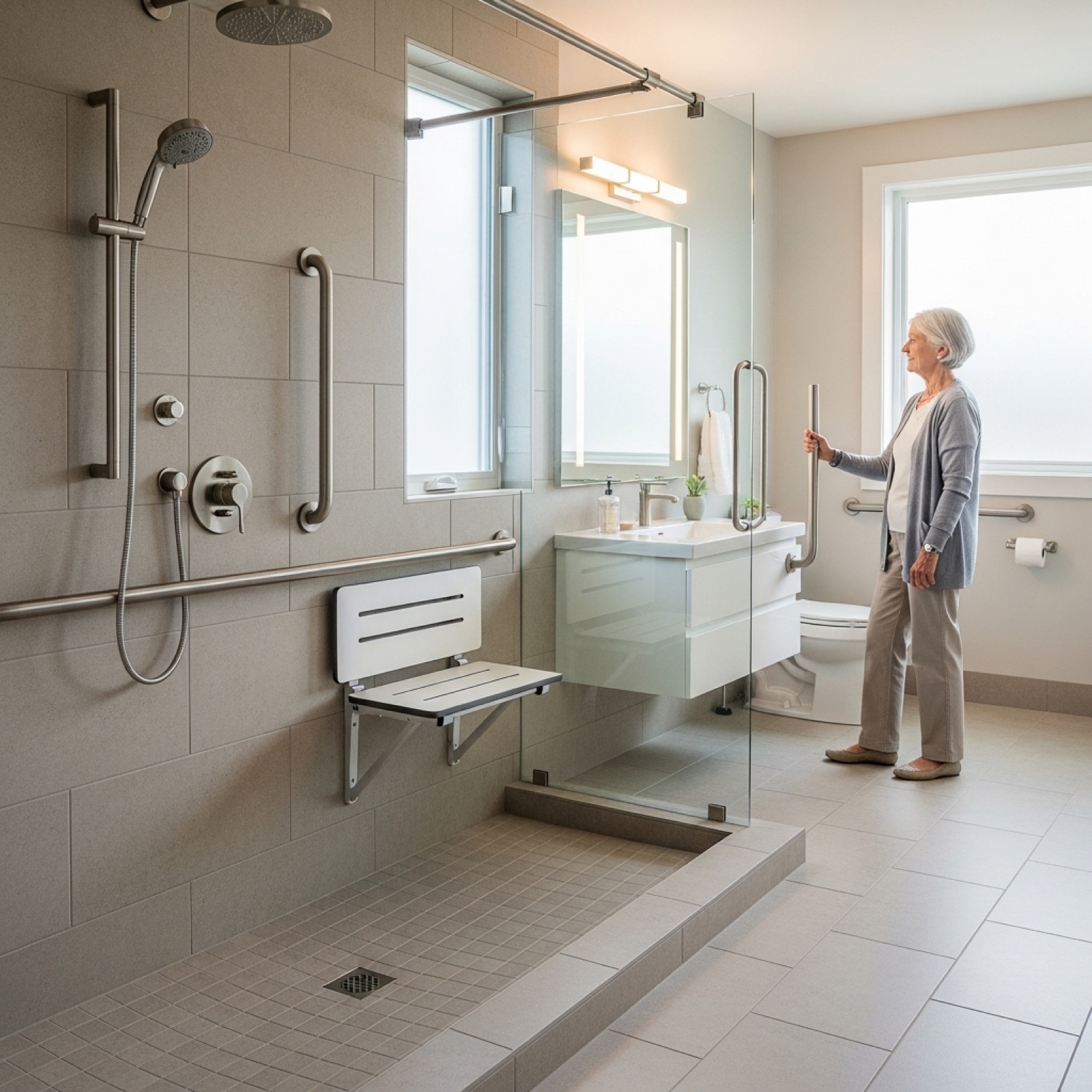
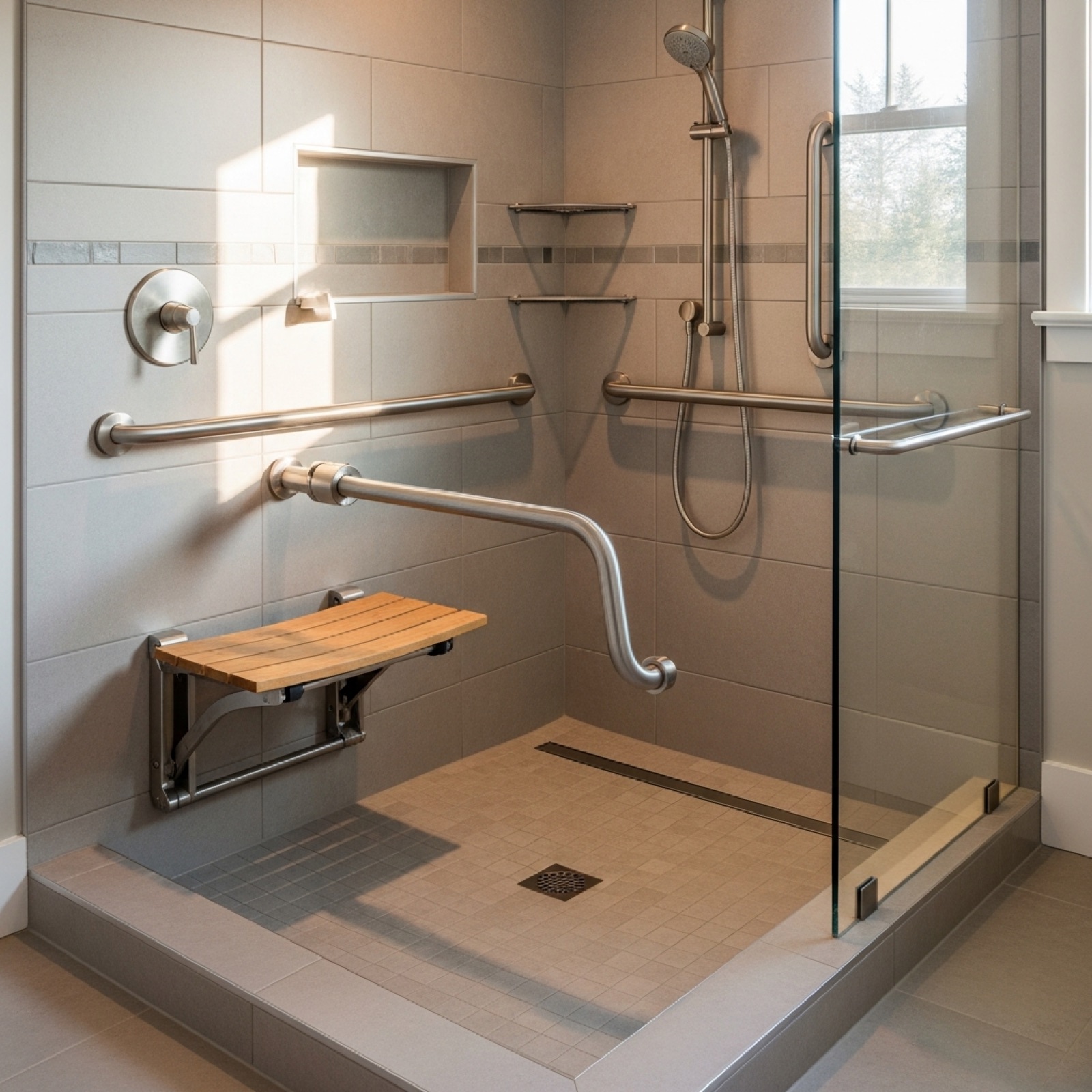
This is where most RAHA projects begin. We recently helped a homeowner in Sardis convert a standard bathtub to a zero-threshold walk-in shower under BC RAHA. The existing tub was a genuine fall hazard given her mobility situation, and the conversion addressed that directly.
From the time her application was submitted to the day the job was complete, the process took about eight weeks, including the approval wait. The finished bathroom looks like a renovation, not a medical installation. Grab bars, non-slip flooring, and improved lighting in the shower and toilet area are all covered.
Entry access and exterior stairs
Getting safely in and out of the home is a common challenge, particularly in winter when exterior steps and thresholds become slippery. Ramps, handrails, exterior lighting, and wider entryway clearance are all eligible. Lever-style door handles in place of round knobs are a small but frequently overlooked item that can make a real difference for anyone managing arthritis or reduced grip strength.
Interior mobility and doorway widths
Wider doorways to accommodate a walker or wheelchair, additional handrails on interior staircases, and threshold strips between rooms with different flooring levels are all within scope. Stair lifts can also be approved depending on the circumstances and the OT assessment.
Kitchen adaptations
Pull-out shelving, repositioned work surfaces, and improved task lighting are among the kitchen items that may qualify, provided they connect directly to the documented disability or ability loss.
- Therapeutic features (soaker tubs for pain relief, jetted tubs)
- Adaptations done purely for ease of cleaning
- General renovation work not tied to the documented condition
- Cosmetic upgrades bundled into an accessibility project
- Work done before written approval (with a narrow exception for emergency adaptations before hospital discharge)
How the Application Process Works
The process is more manageable than it looks on paper. Here is what to expect.
- Contact BC Housing first. Visit bchousing.org/BC-RAHA or use the contact form on their site. A quick inquiry tells you whether you likely qualify.
- Gather your documents and complete the application. Notice of Assessment, proof of status, proof of assets, OT or physiotherapist assessment where required.
- Submit and wait for written approval. Don't start any work until the approval letter arrives.
- Complete the work within 180 days, then submit documentation for the rebate.
Step one: Contact BC Housing before you start anything. Visit bchousing.org/BC-RAHA to reach BC Housing. A quick inquiry can tell you whether your situation is likely to qualify and what documentation you'll need. This step costs nothing and saves a lot of confusion later.
Step two: Complete the application form with supporting documents. You'll need your most recent Notice of Assessment from CRA (or an Option C printout), proof of Canadian status, proof of assets, proof of address, and for adaptations requiring it, a completed home assessment form from an occupational therapist, physiotherapist, or other qualified medical professional. Incomplete applications are not reviewed until all documents are received, so gathering everything before you submit shortens your wait considerably.
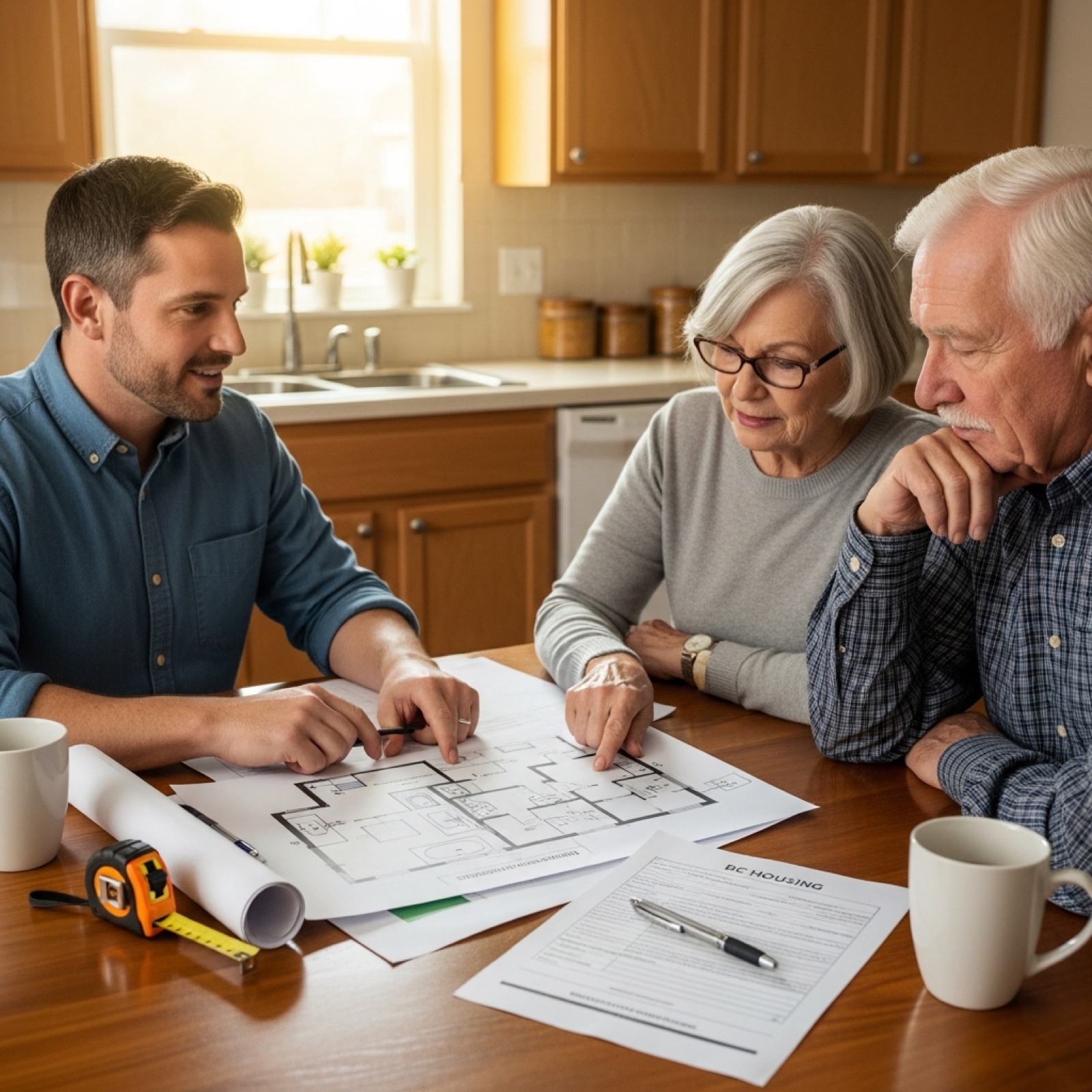
Step three: Submit and wait for written approval. Applications are reviewed in the order they're received. Once reviewed, you'll receive a letter indicating whether you're approved, need to provide additional information, or are not eligible.
Work completed before written approval from BC Housing is not eligible for rebate. The one exception is emergency adaptations required before hospital discharge, with specific documentation requirements. Apply first, get written approval in hand, then start the work.
Step four: Complete the work within 180 days of approval. You choose your contractor — BC Housing does not assign one. Once the work is done, you submit documentation and the rebate is processed. If you need more time, contact BC Housing before your deadline passes.
On the contractor side, what matters is that the estimate is itemized clearly and that the work is documented in the way BC Housing expects. Contractors who have done RAHA work before know this process; contractors who haven't may need more guidance. Either way, making sure your contractor understands the documentation requirements before work starts avoids problems at the rebate stage.
Where Master Painting & Renovations Fits In
BC RAHA projects sit at the intersection of government administration and physical renovation, and that combination has more moving parts than a standard reno. The application needs to be right. The estimate needs to match what BC Housing expects. The work needs to be documented properly for rebate submission.
We've completed a number of BC RAHA projects with homeowners in Chilliwack, Sardis, and Abbotsford, and what we hear consistently is that having a contractor who knows the process reduces the stress considerably. We know how to write estimates that align with BC Housing's documentation requirements, we understand which adaptation categories tend to require OT sign-off, and we're familiar with the timeline so we can plan work around approval windows rather than scrambling after the fact.
Our broader adaptive renovations work covers the same ground whether or not RAHA is in the picture — bathrooms designed for safe long-term use, doorway widening, ramp construction, and the smaller details (lever handles, lighting, threshold transitions) that often matter more than the headline items.
If you're considering applying and want to talk through whether your project is a fit, reach out before you start the paperwork. That conversation costs nothing and gives you a clearer picture of what to expect. You can also use BC Housing's online RAHA Calculator at bcrahacalculator.bchousing.org to get a sense of what your specific adaptations might qualify for before you contact anyone.
The Bottom Line
If you or someone in your household is dealing with a permanent disability or lasting ability loss, and your home is making daily activities harder than they should be, BC RAHA is worth a serious look. Up to $20,000 toward the right adaptations is a meaningful amount of help, and the program exists specifically to keep people in the homes they love for longer.
The process isn't complicated, but the order matters: call BC Housing first, get written approval before any work begins, and choose a contractor who knows the documentation side of the program. If you're not sure whether your situation fits, the ten-minute phone call to BC Housing is the single most useful thing you can do.
And if you'd like to talk through what the actual renovation might look like before you commit to anything, our guide on what to expect at a renovation estimate meeting walks through exactly how that first conversation goes.
For more general renovation questions beyond the RAHA program, see our full FAQ page.
Talk Through Your RAHA Project
Master Painting & Renovations serves homeowners throughout Chilliwack, Abbotsford, Hope, Agassiz, and Harrison Hot Springs. If you're thinking about an accessibility renovation and want to understand how BC RAHA fits in, we're happy to walk through it with you — before you start any paperwork, and at no cost.
Call us at (604) 847-0994 or visit the contact page.
This article is general information only and not a substitute for confirming current eligibility, thresholds, and program details directly with BC Housing.